Guide · Pets · 4 models
How to choose an automatic pet feeder: food type, meals and portions, capacity, power and the multi-pet problem
Automatic feeders are sold on a litre figure and an app, and most buyers find out at home that the litres are kibble only, the app needs the right Wi-Fi band, and the other cat eats everything. This guide explains the four kinds of feeder, how to read meals, portions and capacity, what powers them when the mains fails, and what to do when one pet steals another's food.
Four machines with one name
Every automatic feeder is one of four designs, and the first job is to match the design to the problem.
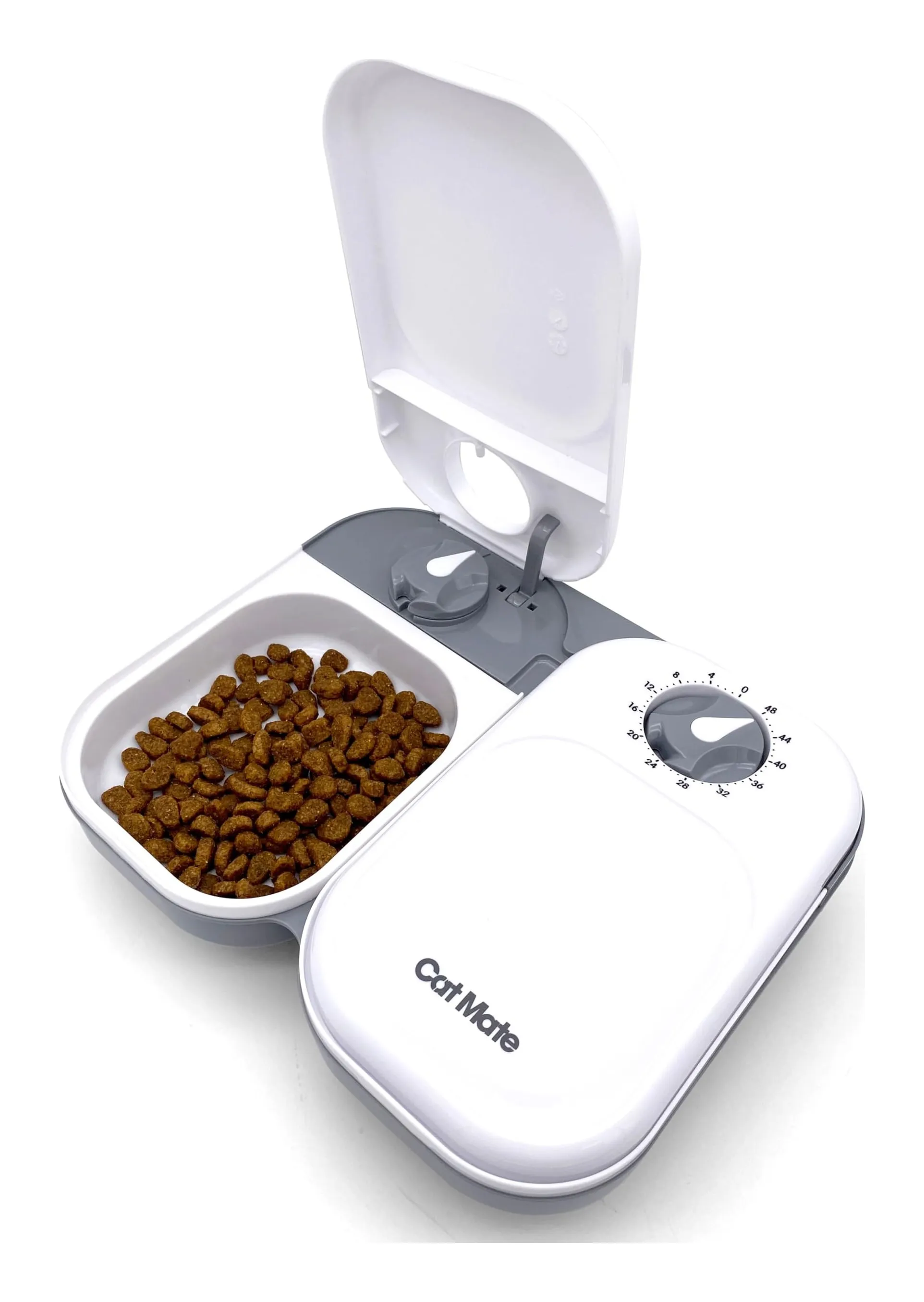
A bowl timer is one or two bowls under lids that spring open when a timer runs down, with an ice pack underneath. It handles wet food, holds one or two meals, needs a battery and no programming. It covers a late night.
a bowl timer: two meals under lids on 48-hour timers
Cat Mate C200 2-Meal Feeder
- Meals
- 2 meals
- Capacity
- 2 × 400 g
- Food
- Wet or dry
- Freshness
- Ice pack included
- Power
- Battery
- Connectivity
- None, mechanical timers
Check price on Amazon
Two 400 g bowls, two 48-hour timers, an ice pack, dishwasher-proof lids and bowls, three-year guarantee. The simplest thing that works.
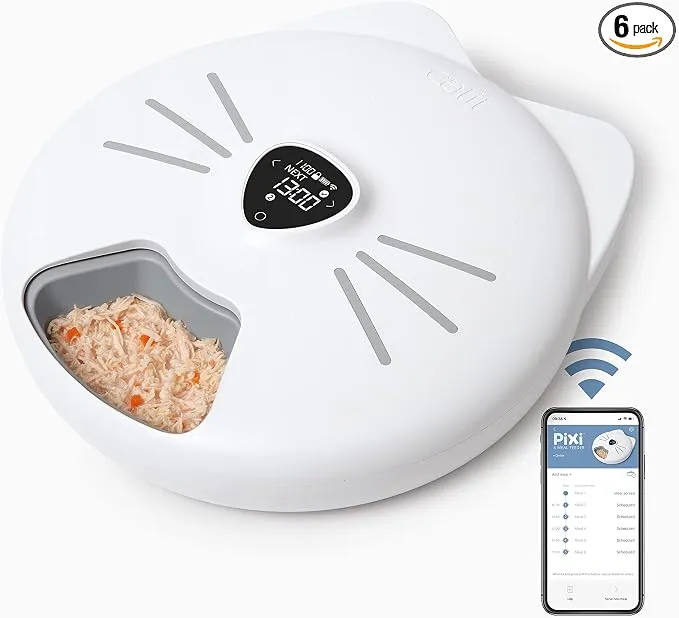
A tray feeder is a carousel of compartments that turns to an opening at set times. Wet or dry, four to six meals, ice packs again, and either a digital clock on the unit or an app. It covers a weekend.
Strengths
- Nothing to programme beyond twisting a dial
- Wet food under a lid with ice
- Three-year guarantee
Limitations
- Two meals and that is all
- Timers are mechanical, 48 hours maximum
Good for
- one day away, or two cats fed at once
Look elsewhere if
- anything longer than a night
a tray feeder: six wet or dry meals on an app schedule, with ice packs
Catit PIXI Smart 6-Meal Feeder
- Meals a day
- 6 meals
- Capacity
- 6 compartments (3.8 l total, listing)
- Food
- Wet or dry
- Freshness
- Two ice packs included
- Power
- Mains; backup 4 × C batteries (not included), about 4 days
- Connectivity
- Wi-Fi 2.4 GHz, Catit PIXI app
Check price on Amazon
Six compartments on an app schedule over 2.4 GHz Wi-Fi, two ice packs, mains power with a four-day battery backup. The connected feeder that does pouches.
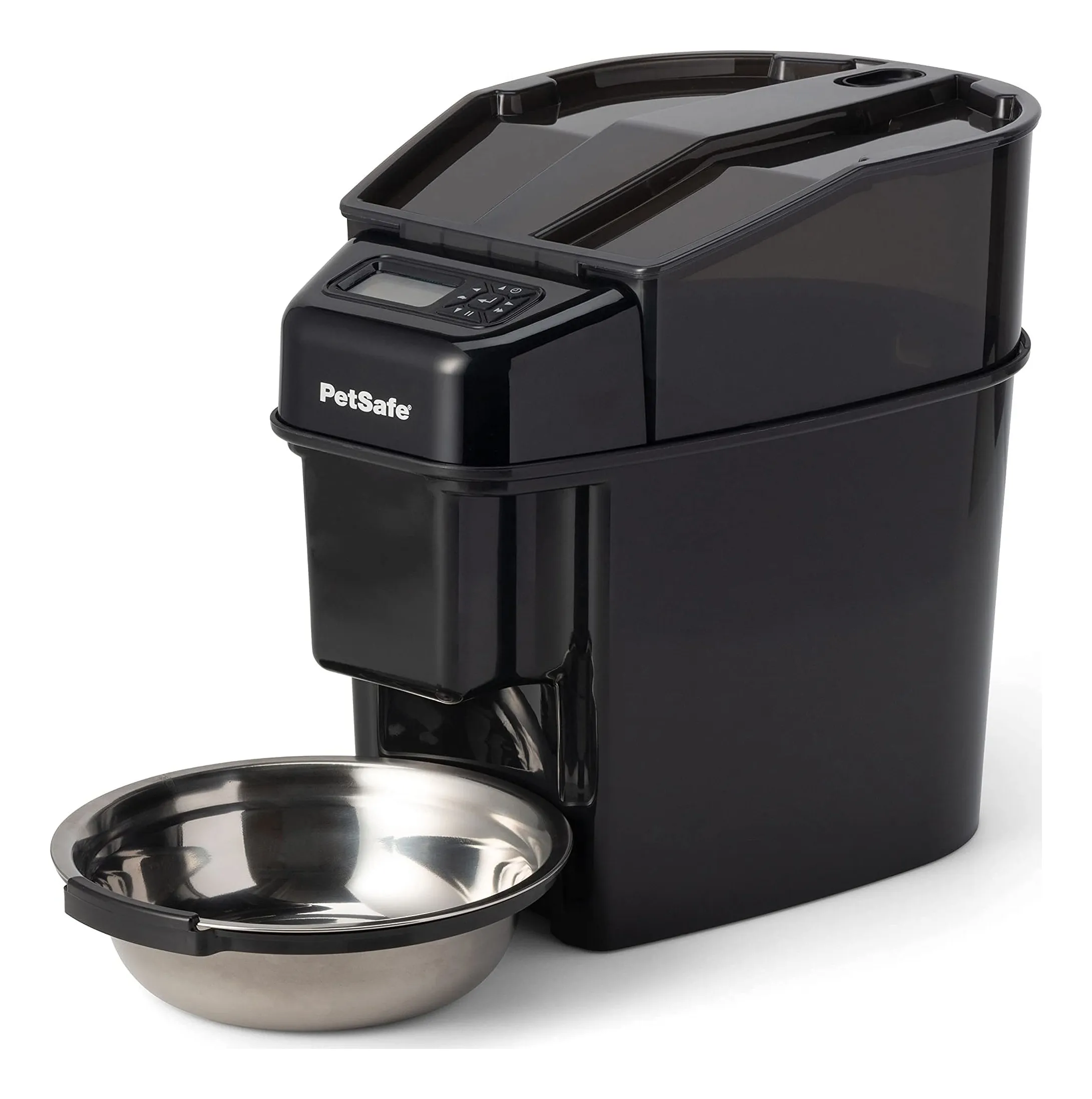
A hopper feeder holds a bag of kibble and drops a measured portion at each meal. Dry only, a week or more, programmed on the unit or by app, with portions from a tablespoon to a bowlful. It covers a holiday, as far as food goes.
Strengths
- Wet or dry, six meals, scheduled from a phone
- Ice packs included
- Battery backup for a power cut
Limitations
- Six meals is the limit; a weekend away, not a week
- 2.4 GHz Wi-Fi only
- Compartment size not published
Good for
- a cat on wet food and an owner who works late
Look elsewhere if
- a week's holiday or a dog
a hopper feeder: 24 cups of kibble, 29 to 946 ml portions, twelve meals a day
PetSafe Healthy Pet Simply Feed
- Meals a day
- 12 meals
- Capacity
- 24 cups (5.6 l, listing)
- Portion
- 29–946 ml, slow-feed option over 15 min
- Food
- Dry only
- Power
- 4 × D batteries; mains adaptor sold separately†
- Connectivity
- None, programmed on the unit
Check price on Amazon
Twenty-four cups, up to twelve meals a day, portions from 29 to 946 ml, a slow-feed mode over fifteen minutes, a stainless bowl. The one here sized for a dog as well as a cat.
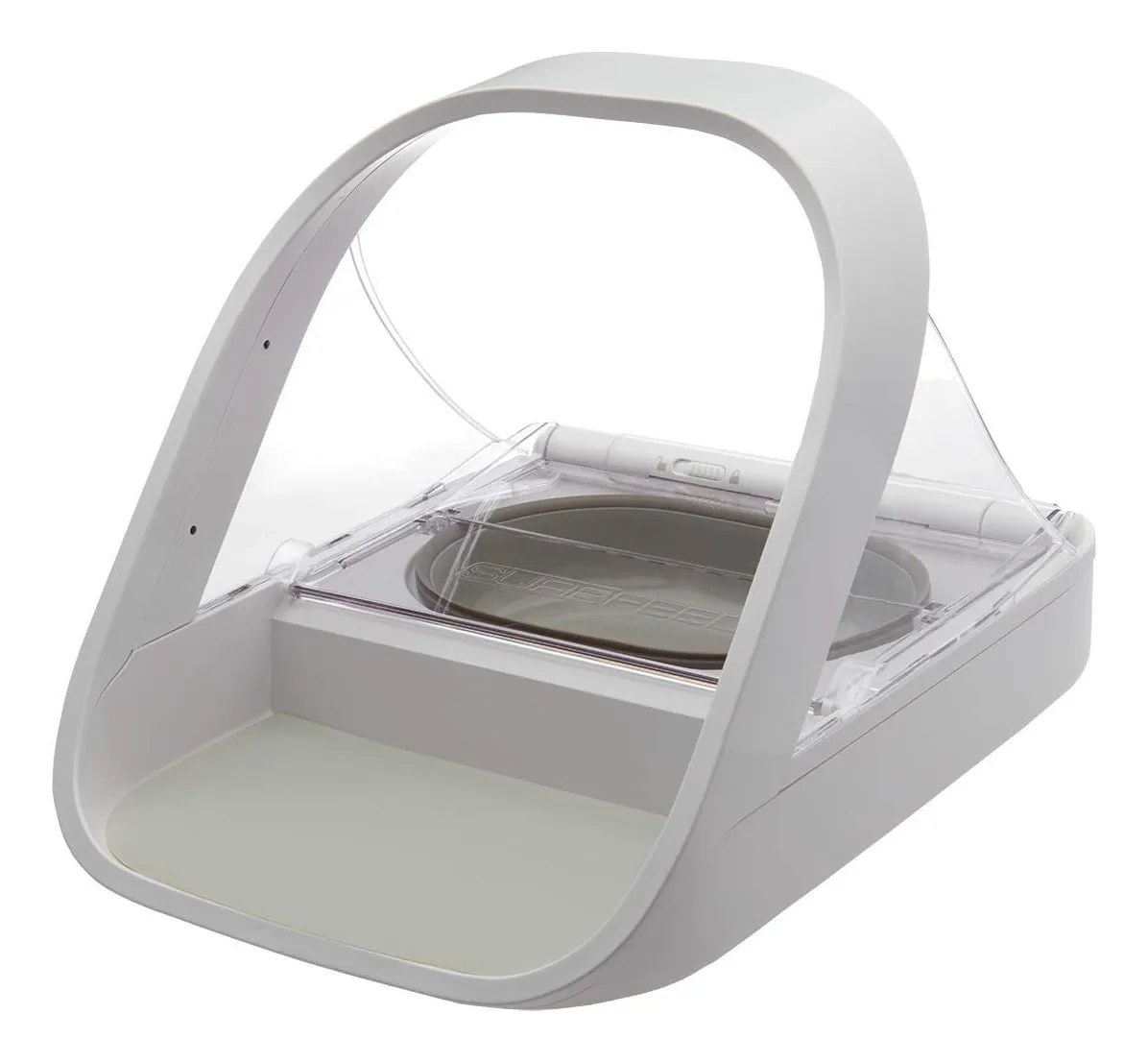
A microchip feeder does not schedule at all. Its lid opens for the pet whose chip or collar tag it has learned and stays shut for everyone else. It solves the one problem no timer can: one animal eating another’s food.
Strengths
- Portions from a tablespoon to nearly a litre, so it suits a cat or a dog
- Slow feed for a gulper
- Twelve meals a day
Limitations
- Dry food only
- Mains adaptor sold separately by PetSafe
- No remote control
Good for
- a dog or a cat on kibble, for a week or more
Look elsewhere if
- wet food or an owner who wants to feed from a phone
a microchip feeder: opens for one pet, keeps the other out
SureFeed Microchip Pet Feeder
- Meals
- 1 bowl
- Capacity
- 400 ml bowl (two pouches); split bowl included
- Food
- Wet or dry
- Access
- Microchip or RFID collar tag, up to 32 pets
- Freshness
- Sealed lid
- Power
- 4 × C batteries, about 6 months
Check price on Amazon
A sealed 400 ml bowl that opens for up to 32 registered pets, six months on four C cells, three-year warranty. For the diet cat in a two-cat house.
Strengths
- Solves the multi-pet problem no timer can
- Sealed lid keeps wet food fresh for hours
- Three-year warranty
Limitations
- One bowl, no schedule: you still fill it
- Needs the cat chipped or wearing the tag
Good for
- a cat on special food in a two-cat or cat-and-dog house
Look elsewhere if
- an owner who wants timed meals while away
Meals, portions and capacity
Three numbers on every listing, and they interact. Meals a day is how many times the feeder will serve: two for the bowl timer, six for the trays, twelve for the hoppers. Portion is how much each time: fixed by the compartment on a tray, adjustable on a hopper, from PetSafe’s 29 ml steps up. Capacity is the total, and it is only meaningful divided by your pet’s daily ration: a 2-litre hopper is about a week for one cat on 60 g a day, less for two.
The common mistake is buying capacity for a holiday and forgetting that wet food on an ice pack is safe for a day, not a week, and that a cat alone for a week needs water, litter and a person whatever the feeder holds.
Power, and what happens when it fails
Mains feeders stop in a power cut; the good ones take batteries as a backup, like the Catit’s four C cells for about four days. Battery feeders run for months on AA, C or D cells (Cat Mate claims a year on three AAs for its C500, Sure Petcare six months on four Cs) and keep going when the lights go out, but need the cells replacing before they die. App feeders also need the Wi-Fi to be up to change anything remotely; most keep the last schedule if the connection drops, which is the thing to check in the manual.
Read the power line for: mains, battery or both; what cells; and whether the maker states a backup time.
Apps and the 2.4 GHz problem
An app lets you change the schedule from the office and see that the feeder ran. Most feeders only join 2.4 GHz Wi-Fi, which is fine until a modern router hides both bands under one name and the feeder cannot find its way on. The fix is in the router, or standing next to it for the pairing. If you do not need remote changes, a feeder programmed on the unit has nothing to pair and nothing to break.
The multi-pet problem
Two cats, one on a prescription diet; or a cat and a dog, where the dog clears every bowl. No timer solves this, because a timer opens for whoever is there. The microchip feeder opens only for the right animal and closes behind it, and it is the only reliable answer short of feeding in separate rooms. It does not schedule, so pair it with a routine, or a second feeder for the other pet.
How to read a listing in five lines
- Food: wet or dry. Hoppers are dry only.
- Meals a day, and whether the portion is adjustable.
- Capacity, divided by your pet’s daily ration.
- Power: mains, battery, backup time.
- Access control, if another animal is the problem.
Which kind, by situation
- Late home one night, wet food: a bowl timer.
- A weekend away, wet food: a tray feeder with ice packs.
- A week on kibble, with someone checking water: a hopper feeder.
- Remote changes: a tray or hopper with an app, on 2.4 GHz.
- One pet stealing another’s food: a microchip feeder, plus a routine.
Sources
Facts checked 23 October 2026
- Catit — PIXI Smart 6-meal Feeder product page and manual — Manufacturer documentation, checked 23 October 2026
- Amazon listing (Catit) — Retailer listing, checked 23 October 2026
- PetSafe UK — Healthy Pet Simply Feed product page — Manufacturer documentation, checked 23 October 2026
- Amazon listing (PetSafe) — Retailer listing, checked 23 October 2026
- Sure Petcare — SureFeed Microchip Pet Feeder product page — Manufacturer documentation, checked 23 October 2026
- Amazon listing (SureFlap) — Retailer listing, checked 23 October 2026
- Closer Pets (Cat Mate) — C200 two-meal automatic feeder product page — Manufacturer documentation, checked 23 October 2026
- Amazon listing (Cat Mate) — Retailer listing, checked 23 October 2026
Wet food or dry: does it change the feeder?
Completely. Hopper feeders drop kibble through a chute; a pouch would jam it. Wet food needs a tray or a lidded bowl with an ice pack under it, which limits you to two to six meals and a day or two of freshness. If the cat is on wet food, the hoppers are out, however good the app.
How many meals a day do I need?
As many as you feed now, plus one for a late train. A cat fed twice is two meals; a kibble-grazer or a cat with a sensitive stomach does better on four to six small ones, which is what the twelve-meal hoppers and six-compartment trays are for. A feeder that offers fewer meals than you feed now is a bowl, not a feeder.
How long will the food last?
Divide the capacity by the daily ration. A 2-litre hopper holds about a week for one cat on 60 g of kibble a day; the 24-cup PetSafe holds two to three weeks for a cat or a week for a medium dog. Tray and bowl feeders hold two to six meals. Then subtract the limit that matters: wet food is only safe for a day or two on ice, and the cat runs out of water and litter before food.
What is 2.4 GHz Wi-Fi and why do feeders insist on it?
The older, longer-range Wi-Fi band. Most cheap smart devices only use it, and a router that merges both bands under one name can confuse them during setup. If your feeder will not connect, split the bands in the router or stand next to it with your phone on 2.4 GHz for the pairing.
Related reading
Shortlist · Pets
Best automatic pet feeders: six feeders from a two-bowl timer to a microchip lock, by what each actually does
Automatic feeder is one name for four machines: a lidded bowl on a timer for wet food, a tray that turns to the next meal, a hopper that drops measured kibble, and a lid that opens only for the right cat. Which you need depends on the food, how long you are away and how many animals eat. Six feeders from Catit, Cat Mate, PetSafe, Petlibro and Sure Petcare, on the makers' figures.
Shortlist · Pets
Best pet water fountains: six fountains from 2 to 7.5 litres compared on capacity, filter, power and material
A fountain gets a cat to drink, which is most of the point, and then asks you to clean it weekly and buy filters monthly. What decides which one is capacity against the animals drinking, the filter and how often the maker says to change it, whether the pump runs from the mains, USB or a battery, and the bowl's material. Six fountains from Catit, Cat Mate and PetSafe, on the makers' figures.