Shortlist · Car · 6 models
Best tyre inflators: six 12 V and cordless pumps compared on pressure, speed, hose, power and weight
A tyre inflator turns a warning light into a two-minute job instead of a trip to a forecourt with a bag of coins. The figures that matter are how fast it moves air, whether it stops at the pressure you set, how far the cable and hose reach, whether it runs from the car's socket or its own battery, and whether it will do a bicycle. Six pumps from Ring, Bosch and Michelin, on the makers' figures.
Quick answer
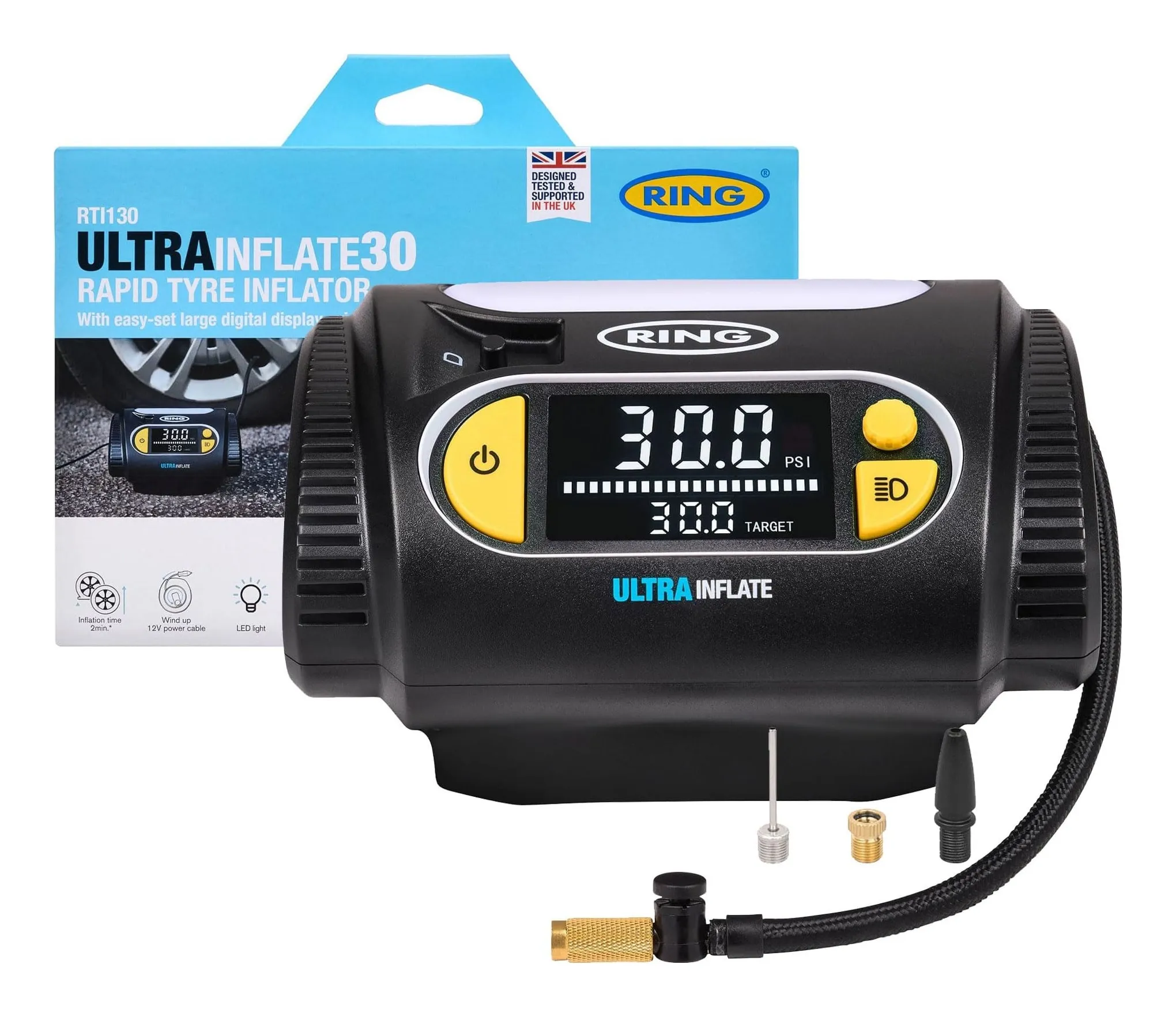
- 100psiFastest plug-inRing UltraInflate 30: 180 W, a 13-inch tyre to 35 psi in about 2 minutes, 3.5 m cable, 70 cm hose, auto-stop.
- 120psiCordless with a 12 V fallbackRing TyreInflate GO 4: 120 psi, USB-C charging, 12 V cable in the box, memory for each car, torch.
- 100psiCompact plug-in with auto-stopRing UltraInflate 20: the same 100 psi and auto-stop, 3.5 minutes on Ring's test, wind-up 3 m cable.
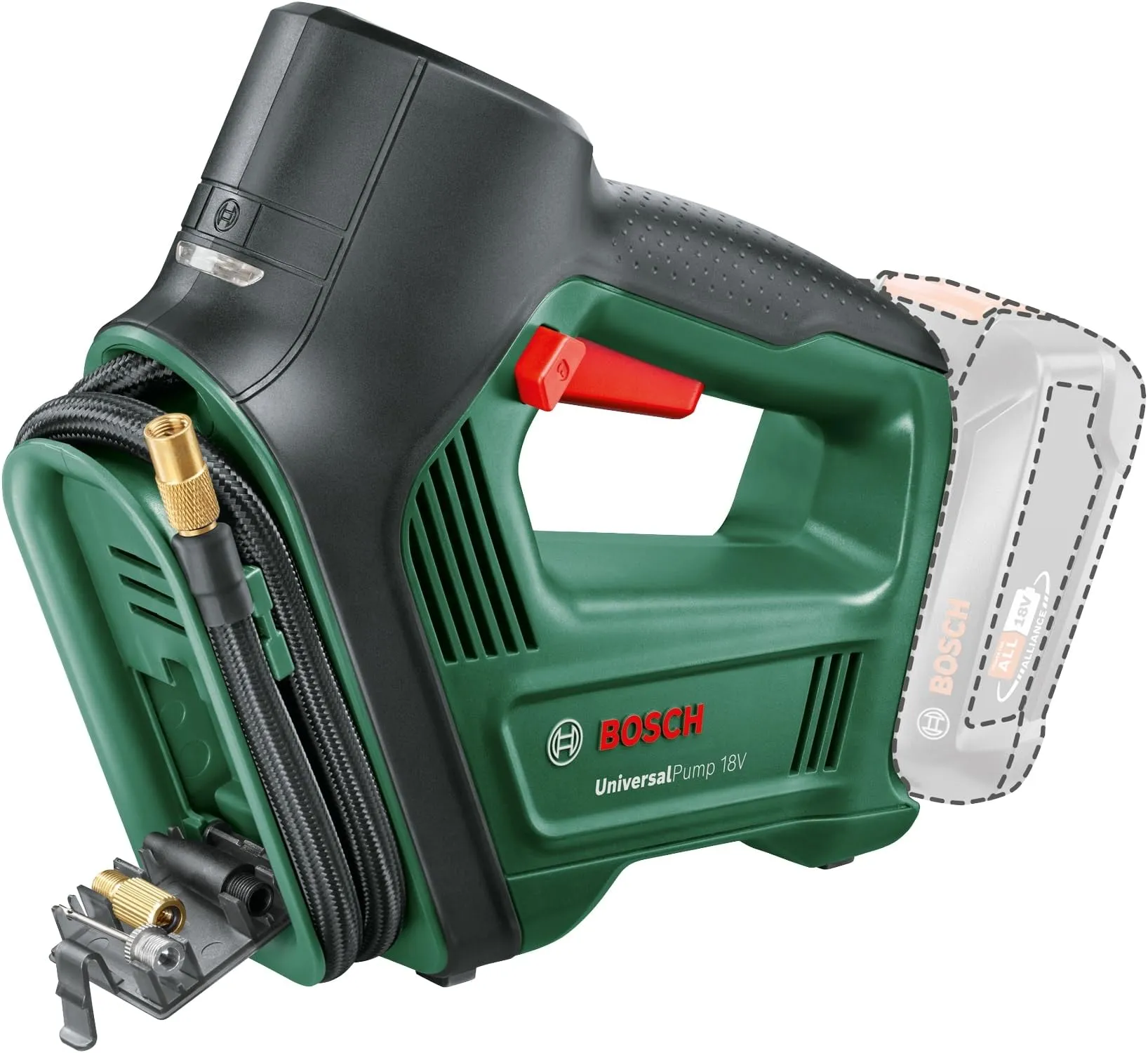
- 150psiFastest cordless, on a battery you ownBosch UniversalPump 18V: 30 l/min to 10.3 bar on any Power for All battery; sold bare.
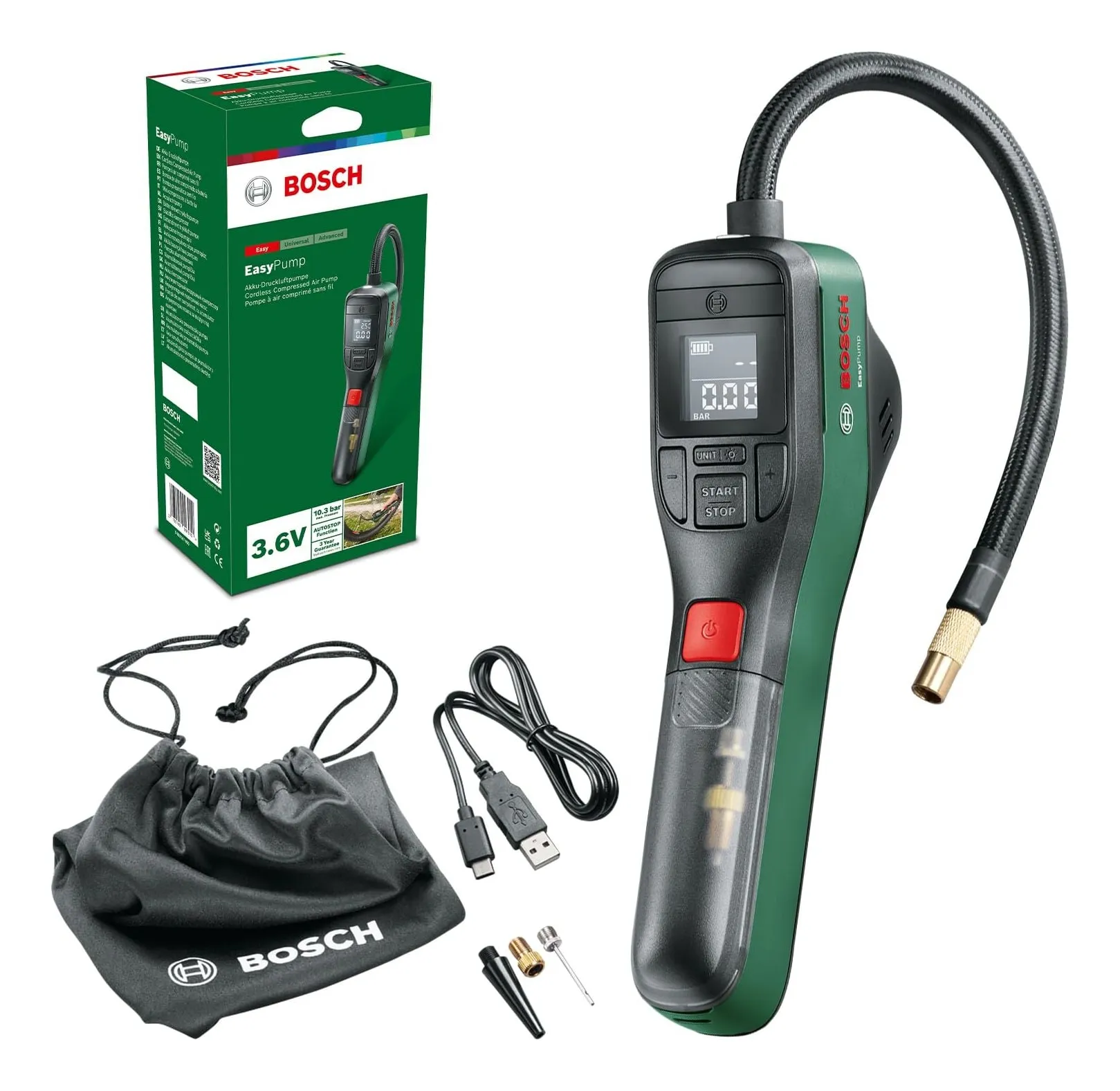
- 150psiBikes, balls and top-ups in a pocketBosch EasyPump: 430 g, 150 psi, auto-stop, Presta adapter, USB charging.
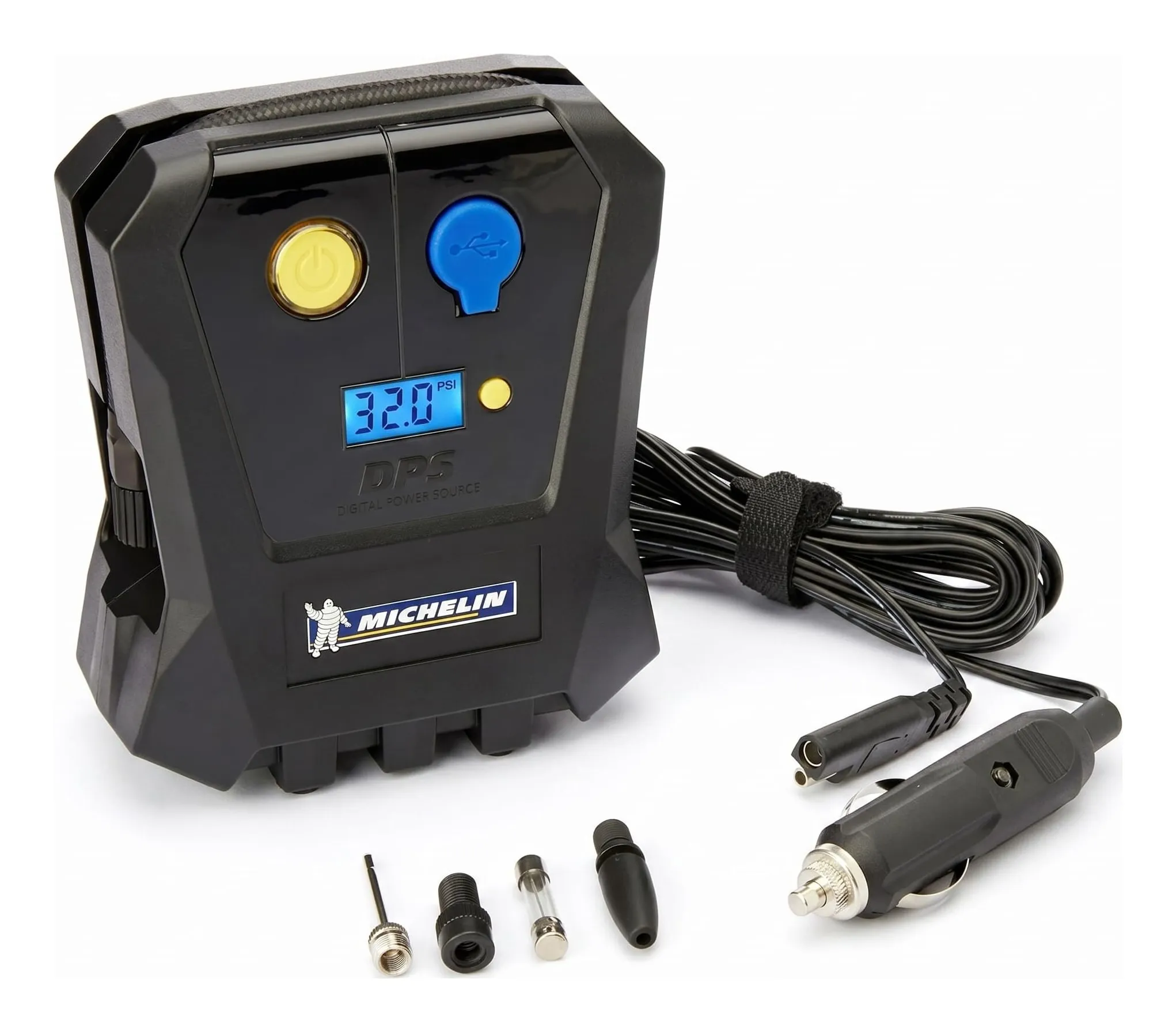
- 50psiGlovebox emergency compressorMichelin 009518: 360 g, 3.5 bar, digital gauge, 10 cm hose.
The six at a glance
| Model | Max pressure | Power | Air hose | Ring's inflation figure | Weight | Where to buy |
|---|---|---|---|---|---|---|
| Ring UltraInflate 30 (RTI130)for the fastest plug-in | 100 psi | 12 V socket, 180 W, 3.5 m cable | 70 cm | 13 in tyre to 35 psi in about 2 min | 1.16 kg | View listing |
| Ring TyreInflate GO 4 (RTC4000)for cordless with a 12 V fallback | 120 psi | Internal Li-ion, USB-C charging; 12 V cable as backup | 60 cm | 15 in tyre from flat in under 6 min | 1.02 kg | View listing |
| Ring UltraInflate 20 (RTI120)for a compact plug-in with auto-stop | 100 psi | 12 V socket, 180 W, 3 m wind-up cable | 60 cm | 13 in tyre to 35 psi in about 3.5 min | 1.1 kg | View listing |
| Bosch UniversalPump 18V (bare tool)for the fastest cordless, on a battery you own | 150 psi | 18 V Power for All battery, not included | 67 cm | No confirmed data | 1.2 kg | View listing |
| Bosch EasyPumpfor bikes, balls and top-ups in a pocket | 150 psi | Built-in 3.6 V 3.0 Ah battery, USB charging | 20 cm† | No confirmed data | 0.43 kg† | View listing |
| Michelin 009518 Mini Digital Compressorfor a glovebox emergency compressor | 50 psi† | 12 V socket, 72 W† | 10 cm† | A standard car tyre in about 4 min† | 0.36 kg† | View listing |
Scroll sideways to see every column
† Figure from a retailer listing or otherwise awaiting confirmation from the manufacturer; other figures come from manufacturer manuals and leaflets.
Ring and Bosch publish specification sheets and the table uses them. The Michelin has no maker page and its listing gives two different maximum pressures, both recorded. Inflation claims are each maker’s own test, not comparable between makers.
Air per minute, and the number makers hide
A pump’s job is to move air, and the useful figure is litres a minute: Bosch states it (30 for the 18 V tool, 10 for the EasyPump), the Michelin 7, and Ring gives a time for a specific tyre instead, which amounts to the same thing if you know the tyre. A 13-inch tyre from flat to 35 psi in two minutes is a fast domestic pump; four minutes is ordinary; a 10-litre pump is for bikes and top-ups.
Then the practical figures: whether it stops at a set pressure; how far the 12 V cable reaches, because the rear wheel of an estate is three metres from the socket; how long the hose is, because a 10 cm hose means kneeling; and whether the power comes from the car or a battery.
Ring UltraInflate 30, for the fastest plug-in
for the fastest plug-in
Ring UltraInflate 30 (RTI130)
- Max pressure
- 100 psi
- Power
- 12 V socket, 180 W, 3.5 m cable
- Air hose
- 70 cm
- Ring's inflation figure
- 13 in tyre to 35 psi in about 2 min
- Weight
- 1.16 kg
Check price on Amazon
Ring’s quick one: 180 watts from the 12 V socket, a 13-inch tyre to 35 psi in about two minutes by Ring’s own sheet, a dial to set the target and auto-stop to hit it, a progress meter, an LED light, a 3.5 m cable and a 70 cm hose. Readings in psi, bar or kPa to 100 psi.
It needs the car’s socket, and the listing’s one-year warranty should be checked against Ring.
For a boot-kept compressor that does all four wheels in under ten minutes, it is the one.
Strengths
- Two-minute claim on a 13-inch tyre, by Ring
- 3.5 m cable reaches every wheel
- Ring publishes a specification sheet
Limitations
- Needs the car's 12 V socket; nothing cordless
- Listing warranty is one year, which needs checking against Ring
Good for
- a boot-kept inflator for monthly checks and a slow puncture
Look elsewhere if
- bicycles in the shed, where a cordless pump wins
Ring TyreInflate GO 4, for cordless with a 12 V fallback
for cordless with a 12 V fallback
Ring TyreInflate GO 4 (RTC4000)
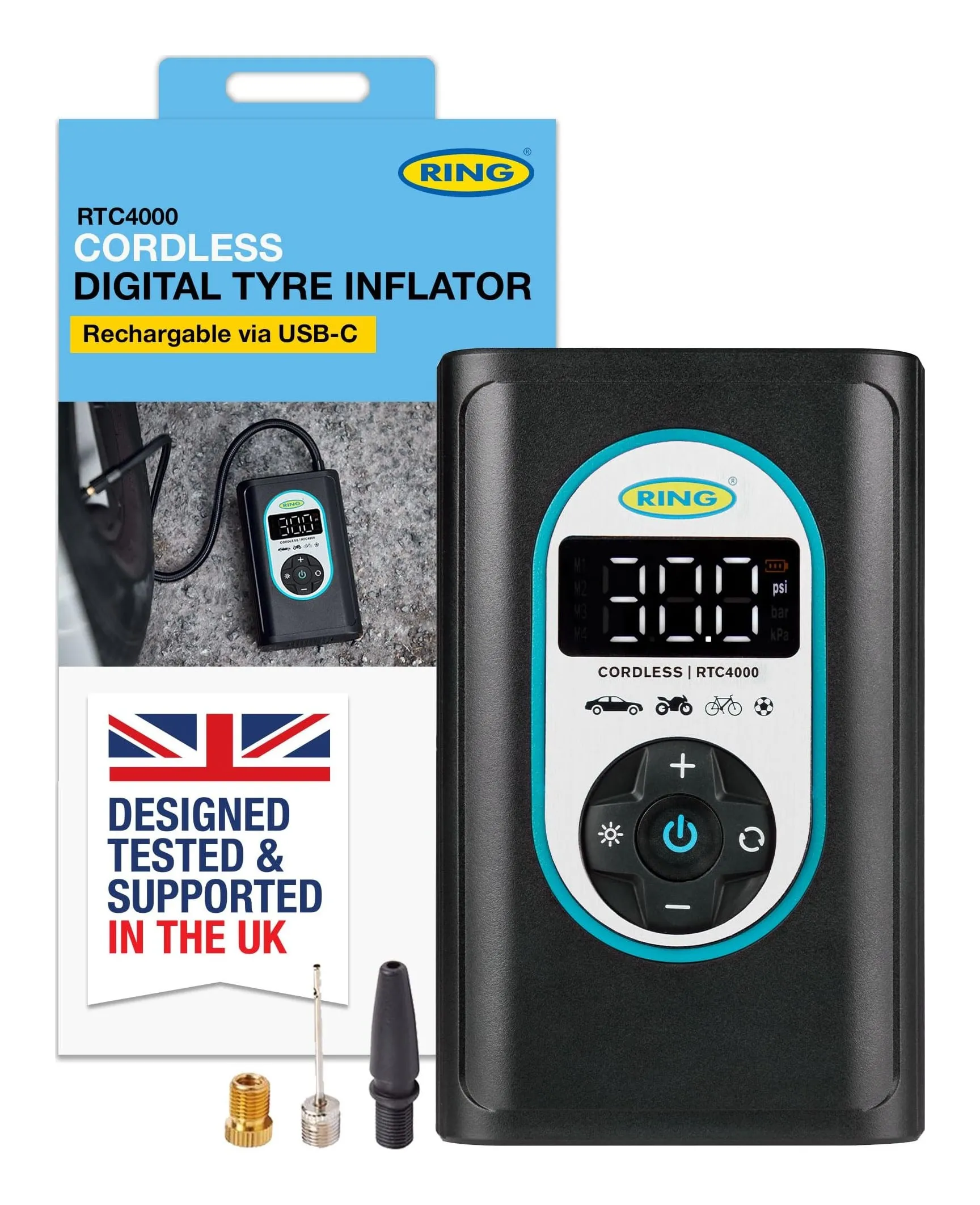
- Max pressure
- 120 psi
- Power
- Internal Li-ion, USB-C charging; 12 V cable as backup
- Air hose
- 60 cm
- Ring's inflation figure
- 15 in tyre from flat in under 6 min
- Weight
- 1.02 kg
Check price on Amazon
A battery inflator with a safety net: an internal lithium pack charged over USB-C, a 12 V car cable for when it is flat, 120 psi, auto-stop with a memory for each vehicle’s pressures, a 60 cm hose, an LED torch, three adapters and a bag, in a 15 by 9.5 by 6 centimetre body. Ring rates it for a 15-inch tyre from flat in under six minutes.
Ring does not publish the battery capacity or how many tyres a charge does, and it is slower than the plug-in 30.
For a household with bikes and two cars, where the pump has to travel, it is the one.
Strengths
- Works away from the car: bikes, a trailer, the other car
- 12 V cable in the box if the battery is flat
- Memory for saved pressures
Limitations
- Battery capacity and tyres per charge not published
- Slower than the plug-in UltraInflate 30
Good for
- a household with bikes and two cars
Look elsewhere if
- someone who only ever tops up one car in the drive
Ring UltraInflate 20, for a compact plug-in with auto-stop
for a compact plug-in with auto-stop
Ring UltraInflate 20 (RTI120)
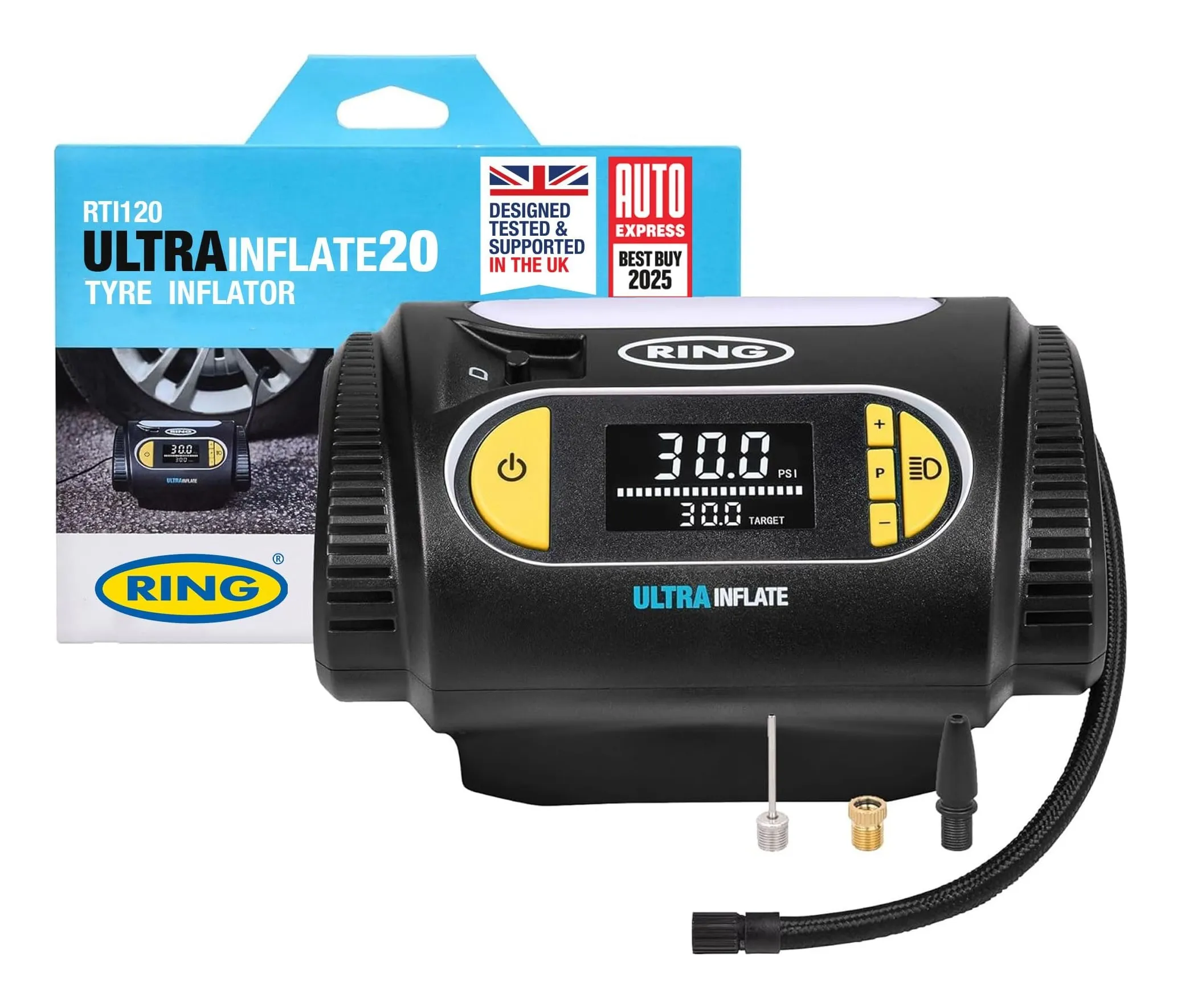
- Max pressure
- 100 psi
- Power
- 12 V socket, 180 W, 3 m wind-up cable
- Air hose
- 60 cm
- Ring's inflation figure
- 13 in tyre to 35 psi in about 3.5 min
- Weight
- 1.1 kg
Check price on Amazon
The UltraInflate 30’s smaller sibling: the same 100 psi reading, auto-stop and progress meter, a 180 W pump that Ring rates at three and a half minutes for the 13-inch tyre, a 3 m cable that winds back into the body, and a 60 cm hose.
A minute and a half slower on Ring’s test, and 3 m may not reach the far wheel of a long car.
For a small car and a glovebox that wants auto-stop, it is the one.
Strengths
- Auto-stop and a digital display at a lower price
- Wind-up cable keeps the boot tidy
- Ring's spec sheet behind the figures
Limitations
- A minute and a half slower than the 30 on Ring's own figure
- 3 m cable may not reach the far rear wheel of an estate
Good for
- a small car and occasional top-ups
Look elsewhere if
- a van or a trailer
Bosch UniversalPump 18V, for the fastest cordless on a battery you own
for the fastest cordless, on a battery you own
Bosch UniversalPump 18V (bare tool)
- Max pressure
- 150 psi
- Power
- 18 V Power for All battery, not included
- Air hose
- 67 cm
- Weight
- 1.2 kg
Check price on Amazon
Thirty litres a minute, three times the EasyPump, to 10.3 bar, on any Bosch home or Flymo 18 V Power for All battery, with an illuminated gauge and the Presta, ball and volume adapters stored on the tool. Sold bare: no battery, no charger.
Bosch does not claim an auto-stop, so you watch the gauge, and without a Power for All battery already in the garage it is an expensive pump.
For anyone with a Bosch 18 V mower or drill, it is the fastest cordless here by a distance.
Strengths
- 30 l/min: a car tyre from flat in minutes
- Runs on the same battery as a Bosch mower or drill
- Adapters stored on board
Limitations
- No battery or charger in the box
- Auto-stop not stated; you watch the gauge
- 1.2 kg before the battery
Good for
- a garage with Power for All batteries already
Look elsewhere if
- anyone buying their first inflator with no battery system
Bosch EasyPump, for bikes, balls and top-ups in a pocket
for bikes, balls and top-ups in a pocket
Bosch EasyPump
- Max pressure
- 150 psi
- Power
- Built-in 3.6 V 3.0 Ah battery, USB charging
- Air hose
- 20 cm†
- Weight
- 0.43 kg†
Check price on Amazon
A 430-gram pump with a built-in 3.6 V 3.0 Ah battery charged from any USB adapter, 150 psi with auto-stop in psi, bar or kPa, a lit display and LED, a 20 cm hose, and adapters for Presta valves, balls and inflatables in a fabric bag. Bosch publishes the whole sheet.
Ten litres a minute: it tops up a car tyre and inflates a bicycle, and it is not for a car tyre from flat.
For a cyclist who also checks the car, or a glovebox pump that does the football, it is the one.
Strengths
- 430 g, charges from a phone charger
- 150 psi with auto-stop: bikes, balls and car top-ups
- Bosch publishes every figure
Limitations
- 10 l/min: slow on a car tyre and not for a flat one
- 20 cm hose
Good for
- a cyclist who also checks the car's tyres
Look elsewhere if
- a van or a flat tyre at the roadside
Michelin 009518, for a glovebox emergency compressor
for a glovebox emergency compressor
Michelin 009518 Mini Digital Compressor
- Max pressure
- 50 psi†
- Power
- 12 V socket, 72 W†
- Air hose
- 10 cm†
- Inflation figure
- A standard car tyre in about 4 min†
- Weight
- 0.36 kg†
Check price on Amazon
The tiny plug-in: 360 grams, 10 by 10 by 15 centimetres, a digital gauge, 7 litres a minute from the 12 V socket, a 10 cm nylon hose with a brass tip, and about four minutes for a standard car tyre by the listing. The listing says 3.5 bar in its text and 6.9 in a field; Michelin, which licenses the name, publishes no page.
Fifty psi is cars only, the hose means kneeling at each wheel, and no auto-stop is stated.
For a compressor that is always in the car for the day the light comes on, it is the smallest.
Strengths
- Fits a glovebox
- Digital gauge
- Four minutes claimed for a car tyre
Limitations
- No maker page; the listing gives two maximum pressures
- 10 cm hose means kneeling at every valve
- No auto-stop stated
Good for
- an emergency compressor that is always in the car
Look elsewhere if
- bikes at 100 psi or anyone who wants to set a target and walk away
How to choose
- Where it lives. Boot, one car: UltraInflate 30 or 20. Shed and two cars: GO 4, Bosch 18 V, EasyPump. Glovebox: Michelin, EasyPump.
- Speed. Fastest: Bosch 18 V (30 l/min), UltraInflate 30 (2 min test). Slowest: EasyPump and Michelin.
- Auto-stop. All three Rings, EasyPump. Not stated: Bosch 18 V, Michelin.
- Bikes. 150 psi: EasyPump, Bosch 18 V. Not the Michelin.
- Maker’s figures. Ring and Bosch publish them.
Who should carry a foot pump instead
A foot pump never goes flat, never blows a fuse and does a car tyre in five minutes of effort. If the pump will be used twice a year at the roadside, it is the cheaper and more reliable answer. The electric pumps are for monthly checks and households with bikes.
Which one, by situation
- Fast, in the boot: Ring UltraInflate 30.
- Cordless, with a fallback: Ring TyreInflate GO 4.
- Compact plug-in: Ring UltraInflate 20.
- Bosch 18 V batteries already: Bosch UniversalPump 18V.
- Cyclist’s pocket pump: Bosch EasyPump.
- Glovebox emergency: Michelin 009518.
Sources
Facts checked 23 October 2026
- Ring Automotive — UltraInflate 30 product page and specification sheet — Manufacturer documentation, checked 23 October 2026
- Amazon listing (RING) — Retailer listing, checked 23 October 2026
- Ring Automotive — TyreInflate GO 4 (RTC4000) product page — Manufacturer documentation, checked 23 October 2026
- Amazon listing (RING) — Retailer listing, checked 23 October 2026
- Ring Automotive — UltraInflate 20 product page and specification sheet — Manufacturer documentation, checked 23 October 2026
- Amazon listing (RING) — Retailer listing, checked 23 October 2026
- Bosch DIY UK — UniversalPump 18V product page and press release — Manufacturer documentation, checked 23 October 2026
- Amazon listing (Bosch) — Retailer listing, checked 23 October 2026
- Bosch DIY UK — EasyPump product page — Manufacturer documentation, checked 23 October 2026
- Amazon listing (Bosch) — Retailer listing, checked 23 October 2026
- Amazon listing (MICHELIN) — Retailer listing, checked 23 October 2026
Plug-in or cordless?
Plug-in 12 V compressors are faster for the money and never flat, but need the car running nearby and a cable that reaches the far wheel. Cordless pumps go to the bike shed and the other car and need charging. The Ring GO 4 does both: a battery with a 12 V cable as backup. If you only ever top up one car in the drive, plug in.
What pressure do I need?
Car tyres run 30 to 40 psi (2.1 to 2.8 bar), vans to about 65, road bikes 80 to 120. Every pump here reaches car pressures; the 150 psi pumps (both Bosch) do road bikes; the Michelin stops at 50 psi, which is cars and nothing else.
What does the inflation time claim mean?
Each maker picks its own test. Ring says a 13-inch tyre to 35 psi, from flat, in about 2 minutes (UltraInflate 30) or 3.5 (UltraInflate 20), and a 15-inch tyre in under 6 for the GO 4. Bosch gives litres a minute instead: 30 for the 18 V pump, 10 for the EasyPump. A top-up of 5 psi takes a fraction of any of these; from flat is the honest test.
Is auto-stop worth having?
Yes. Set the pressure, press start, and the pump stops when it gets there, so you are not squinting at a gauge in the rain. Every Ring here has it, and the Bosch EasyPump; the Bosch 18 V pump and the Michelin do not state it.
Related reading
Shortlist · Car
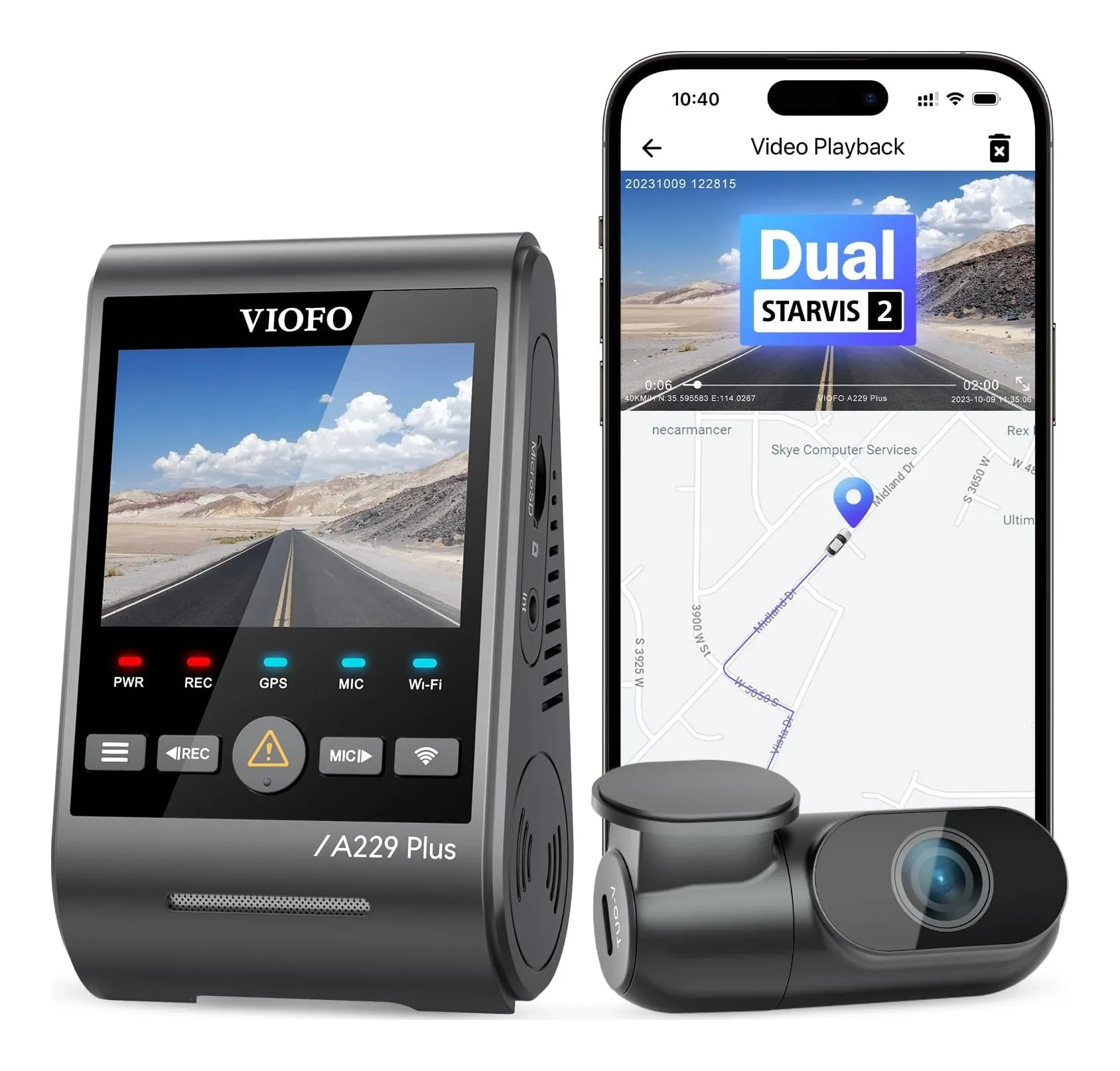
Best dash cams: six front and front-and-rear cameras compared on resolution, GPS, screen and parking mode
A dash cam is insurance evidence. What makes it useful is whether a plate can be read, which is resolution, frame rate and the sensor at night; whether speed and location are stamped on it, which is GPS; whether it records when parked; and whether the back of the car is covered. Six cameras from Nextbase, Garmin, Viofo and 70mai, from a 1080p pocket camera to 4K front and rear.
Guide · Car
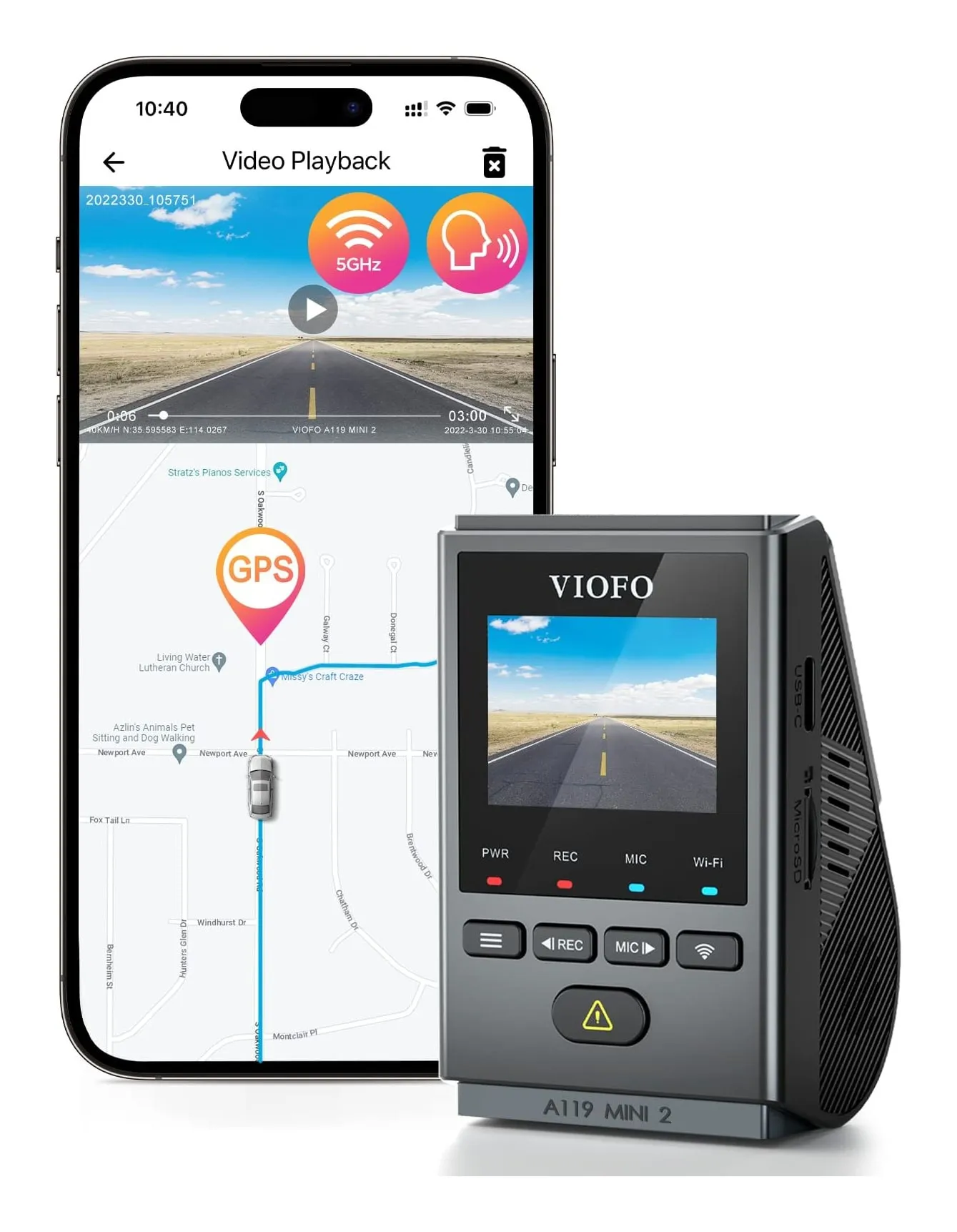
Dash cams explained: resolution and frame rate, field of view, sensors at night, parking mode and the UK rules
Dash cams are sold on a pixel count, and the pixel count is the least reliable predictor of whether a plate will be readable in the clip you hand to your insurer. This guide explains what resolution and frame rate buy, why field of view is a trade, what the sensor does at night, what GPS adds, what parking mode requires, and where a camera may legally sit on a UK windscreen.